
In the fast-paced world of business, understanding and gauging customer satisfaction is crucial for success. Two widely used metrics for this purpose are Customer Satisfaction (CSAT) and Net Promoter Score (NPS). In this blog post, we’ll delve into the history of each metric, provide easy-to-understand formulas, explore the differences between CSAT and NPS, discuss the benefits of automation in obtaining these metrics, highlight the advantages of sourcing feedback from review sites, and finally, explore alternative metrics.
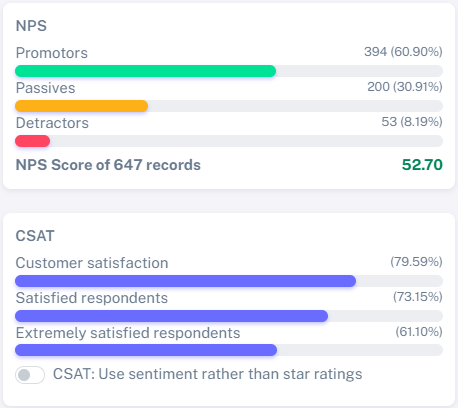
An example of how NPS and CSAT look within the Review Analytics dashboard – these reflect any timeframe you put in so you can compare this month to last month (as an example) as you need.
Customer Satisfaction (CSAT):
CSAT has a long history and has been a staple in customer service since the 1970s. Developed by researchers at the University of Michigan, it was initially known as the American Customer Satisfaction Index (ACSI). CSAT has since evolved into a more generalized term, measuring customer satisfaction on a scale typically ranging from 1 to 5 or 1 to 10.
CSAT Formula:
CSAT is calculated by taking the sum of positive responses (usually ratings of 4 or 5) and dividing it by the total number of responses. The result is then multiplied by 100 to get the percentage of satisfied customers.

Review Analytics offers 3 variations on the CSAT score so you can get a more wholistic feel for the value (note: this can be done by star rating or the sentiment of the review content):
– Customer satisfaction – the composite score by adding up all of the customer satisfaction scores and dividing them by the highest possible score
– Satisfied respondents – divide the total number of customers who are “very satisfied” (5) or “satisfied” (4) by the total number of responses
– Extremely satisfied respondents – divide the number of customers who rated you a 5 by the total number of respondents
Net Promoter Score (NPS):
NPS was introduced by Fred Reichheld in 2003 and quickly gained popularity for its simplicity and effectiveness. It measures the likelihood of customers recommending a company’s product or service to others. Respondents are categorized as Promoters, Passives, or Detractors, and the NPS is calculated by subtracting the percentage of Detractors from the percentage of Promoters.
NPS Formula:

Creators of NPS, Bain & Company, suggest a score: Above 0 is good. Above 20 is favourable. Above 50 is excellent. (We highlight these in Green, anything below 0 is in Red)
Differences between CSAT and NPS:
CSAT primarily measures satisfaction with a specific product or service, providing a snapshot of the customer’s experience. In contrast, NPS focuses on loyalty and gauges the likelihood of customers becoming brand advocates.
Why is Automation Best for These Numbers?
Automation plays a crucial role in obtaining accurate and real-time CSAT and NPS data. Automated review monitoring, surveys, email campaigns, and chatbots enable businesses to collect feedback promptly, analyze trends, and address issues swiftly. This not only saves time but ensures that customer sentiments are captured at the right moment.
Getting the Number from Review Sites (like Review-Analytics does) is Good Because…
Review sites act as invaluable platforms for gathering CSAT and NPS data. Customers often share their experiences spontaneously, providing authentic feedback. Monitoring review sites allows businesses to identify trends, address concerns, and showcase positive testimonials, contributing to a comprehensive understanding of customer satisfaction.
Alternatives to NPS and CSAT:
While CSAT and NPS are widely adopted metrics, alternative approaches exist. Customer Effort Score (CES) measures the ease with which customers can accomplish their goals, offering insights into the overall customer experience. Customer Churn Rate is another alternative, indicating the percentage of customers who stop using a product or service over a specific period.
Conclusion:
In the dynamic landscape of customer satisfaction metrics, understanding the history, differences, and nuances of CSAT and NPS is essential for businesses aiming to enhance customer experience. Automation streamlines the process of obtaining these metrics, for which review sites offer a rich source of unfiltered customer feedback.
 Review Analytics